Tuesday, 18 March 2014

RESEARCH

 I began my fundamental audience research by uploading a survey on Smart Survey with questions involving gaming. I had uploaded the Survey onto two social media website, Facebook & Tumblr. On both blog posts, I specifically asked that "Gamers" answer this survey only, as they are the target audience, no matter what age. I realise that they are my Primary Audience & the Secondary Audience must be whoever tunes into Channel 4 at the time where the 3MW's are shown. 


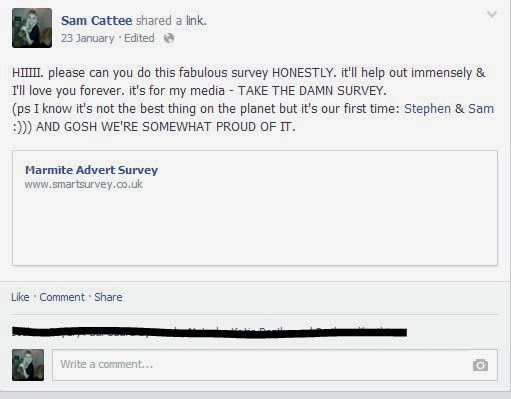
This is the status that I had posted onto Facebook. From the very beginning I had explained how vital it was for me to only have people who had played (or still playing) games respond, so I could get the correct results from the audience I wish to target.


I first asked if people had played Multiplayer with any Family Members. The majority of the answers had said Yes - which I happy with! I didn't want to be the only person that was interested in playing video games with my family. The examples I had used in the question were the games that I had played when I was younger with my family, Mario Kart & Wii Sports with my parents & brothers, whereas I had played Halo with my older brother - so technically they are the people who introduced me to violence. 


Linking in to this question, I had to conclude who the audience preferred playing with & why they do. These were the options & these were the results (below). Unfortunately Family wasn't as popular as I had hoped, but I had more teenagers answer the question more than anything whereas I could have taken into consideration asking anybody younger than 15. 


Going back to the first question to where most people had been introduced by a family member, I was hoping more people had maybe continued with the roots of playing with the family, but at the same time the responses explaining why they didn't was because the family members found it difficult to understand some of the games that they played or they didn't want to show their competitive side with their family. I agreed with most of the responses explaining why they would play with some people. Here are some of the best responses:


To summarize, I still believe doing this documentary will open up the world of playing video games with families, whether they are classed as relatively easy games for them to understand or all out RPG games. Regardless to whether it's playing with a family member or a friend, most of my responses from my audience had said they preferred playing alongside other people as it gives them the chance to pick up on something new, whether it's a Co-op Campaign or Head to Head. My last question was to just ask if people were interested in watching the idea of my documentary, with a sentence of the proposal (as I can't really explain it all in one question on a survey!) & I was happy with the 35 people that had said yes. 


I have also researched into if it's a good idea to begin playing games with family & the exact benefits from playing. It's different from when my parents where younger - without a TV or electricity, so for them it involved good old fashioned board games. Personally, although board games were a lot of fun, as a competitive family we ended up screaming at each other... especially playing Monopoly. There isn't a lot of direct research on to how many families sit & actually play video games together, but from a younger age parents will monitor & choose the games they think their child can play. Research showed that most adults didn't like playing games because they had said it was time consuming & some of the controls were difficult to pick up on. I can relate this to games that are RPG controlled, like World of Warcraft or something because I think they are difficult controls on the computer but I believe video consoled gaming is a lot easier for adults to try & comprehend. 


There are a lot of differences that adults seemed to have picked up on with having children who play games. When starting off at a young age, girls & boys seem to play games that used a lot of colours, have a main protagonist who could be well known - on cartoon shows that they watch. As they grow up, typically boys tend to go for shooting, racing & action/adventure games whilst girls stick to games that are puzzling. (I personally don't believe this research to be true, it depends on what age range of people they asked & when. Only because I know a lot of girls that love shooting games!)


Further research has shown that parents who have previously played video games are more lenient towards their children playing games. Whereas other parents will feel secluded as they don't understand gaming as much as the children who are committed. Parents who tend not to understand just brush off gaming as a waste of time because of the challenge they face with it.

Luckily my parents just have to be used to the gaming in our house because we all do it! I admit, playing alone or with friends can have its advantages rather than playing with family because my mum doesn't like games that involves shooting zombies whereas the rest of my family do. Family gaming has had an ongoing debate for a very long time, which to this day, has still not been resolved. I hope that my documentary will help some people understand that gaming isn't all that bad & it hasn't influenced us to act in bad behaviour including violence etc. 


Bibliography:
  • http://confidentingrace.wordpress.com/2013/08/18/benefits-of-playing-games/ 
  • http://archive.futurelab.org.uk/resources/documents/lit_reviews/Gaming_in_Families_review.pdf
  • http://en.wikipedia.org/wiki/Role-playing_game
  • http://en.wikipedia.org/wiki/Video_game_console

Friday, 14 March 2014

PROPOSAL

I plan on creating a 3 Minute Wonder about my family & how gaming runs through our family. From my Dad's generation from when he was a child to how it has evolved & progressed today. I have decided to do this idea as it's a topic I believe I am passionate about & my whole family are too (not so much my Mum but she had her days). I also want to want to show that playing games hasn't influenced us in any way, how we feel about gaming & how far it has come today. I will be presenting this documentary as an Expository styled with elements of Interactive. This will be presented with voiceovers, images & footage of some of the games that has changed. For example I will be including Super Mario World on the Snes & New Super Mario Brothers on the Wii.


My family are naturally quite funny people, so I hope to create a warm, funny atmosphere that people can laugh at. I guess the genre will most likely fall into the Reality TV Category, but without all the unnecessary drama/arguing sequences, it's just my family at home!
3 Minute Wonders are small documentaries that are shown at 7:55pm during Peak Time where adults or families will most likely be tuning in. This will be my Secondary target audience as they will be the first to witness the 3MW. This could also change the ways that some adults perceive video games. My family & I love playing video games & it's something that we have all been bought up doing & it's become a hobby. I love days where we would all sit on Mario Kart & play, it's just like playing a board game. My Primary audience will be Gamers (which isn't very broad but it's the group of people that will probably find it most interesting & may actually spare some time to watch, this is because I believe the gamers who remember playing on the old consoles will have the chance to reminisce and can now reflect on what we have nowadays. I also believe that the younger audience of gamers need to notice this generation gap which is escalating quickly.


By creating this 3MW the aim of the documentary would be just to show how far gaming has come & how my family feels about it. This documentary isn't going to be a touching, sensitive documentary I just hope the viewers will feel like games haven't influenced us in a bad way & that we're not strange or anything. I want to show the viewers how far gaming has come, from graphics to soundtracks from character development to storylines etc. I also want to show what I grew up with to what I have now.


I will be filming at my house in Gorleston so I will not have any difficulties getting to any locations. The only issue I face is that I will have to borrow some media equipment over night for an evening or two as every family member that I want to be in this documentary works full time. Other than that, everything will be relatively easy to access. I will not need to wear any costumes, neither will my family. Everything I need (excluding equipment) will be at my house, I'm just hoping that I still have all the cables for the consoles so I can collect some footage from each of the games to show the progression. If not, I will have to go on YouTube & get somebody else's recorded footage. I won't need a budget to pay for anything like I've said before, everything is already provided!

Sample Questions:
  • How long have games been part of your life?
  • Do you still see games the way you did when you were a child?
  • What does gaming mean to you?
  • How far has gaming progressed since you were a child?


Tuesday, 4 March 2014

TECHNICAL ASPECTS OF VIDEO EDITING

1. What do the numbers 16:9 refer to?
The numbers refer to the Aspect Ratio. 16 being the width & 9 being height.

2. What is the frame size of a 1080p video file?
1080 pixels high by 1920 wide

3.   If you have a video file which is 720:50p. What is the frame rate and what does the p stand for? 
The frame rate is 50p & the 'P' stands for Progressive.

4.What is the difference between P & I?
P (meaning Progressive) shows every pixel in the frame & I (interlaced) only shows half a frame.

5. What frame rate is real film shot at?
24. But precisely 23.976

6. What might be the advantage of shooting at a higher frame right?
One advantage is that any slow motion in the media production will run smoother.

7. What defines a lossy file?
A file where data is discarded which is deemed not necessary for human perception, in order to keep the file size smaller.

8. Name three file types commonly used in video editing
MP3, MP4 & MOV

9. What is the difference between a video file type & a Codec?
If the file type is the container, then the Codec is how the video & audio is compressed to get inside, then decompressed to read it again. Codec actually means coding/decoding. 
If 
10. What is Bitrate?
Bitrate is the rate at which a file processes information. 


Monday, 3 March 2014

3 MINUTE WONDER RESEARCH

A 3 Minute Wonder is basically a documentary broadcast-ed on Channel 4 during the prime television time. This gives a chance for documentary/film makers for viewers to see their work.

I have decided to use this as an example because I like the style of Documentary. I also like the subject that they have decided to address. It's an ongoing argument that people are having about Street Art regarding whether it's art or vandalism & this documentary mostly addresses why the artists do it. I also thought it was comical when we see the guy create what he believes is art & throws it on top of the bus station & we get that angle on the lady giving him a weird look. I think the style of this particular documentary is a Expository Documentary. 


This documentary just put me in a good mood! I love how happy he is, in spite of everything he has been through! I don't like the style of this one as much as I did in the one before this. I don't think I liked it as much because the main character was strangely focused on - if that makes any sense. I can't really describe what or how it's done but I just don't like it (without seeming a bit rude). I think this documentary is a blend of Observational - as we get a look into his life & who he is but we also have elements of Expository as we have him narrate as a voiceover.


I love this documentary! IT'S SO CUTE. I like the style - especially the voiceover narration because he seems so natural in front & behind the camera & with everything he says about his son. I like how we also focus around where Seyi & Isaac live - showing where Isaac will grow with Seyi. I also like him as a person, I like how he really wants to be in Isaac's life because his father wasn't involved with his & we as the spectators learn how that has affected him. I believe this documentary has Expository & Interactive elements, as they are one sided interviews with the film maker. We don't get a balanced argument as it's just his views on being a single father.


TV Listings - CHANNEL 4:
5:30pm 06/03/2014 - Superstar Dogs: Countdown to Crufts
8pm 06/03/2014 - The Hoarder Next Door
9pm 06/03/2014 - The Floods That Foiled New Year
11pm 06/03/2014 - The CCTV Traffic Wardens
12am 06/03/2014 - One Born Every Minute

These are the documentaries that are being shown on Channel 4 today. This is roughly 4 and a half hours out of the full 24. There a lot more documentaries usually shown on Channel 4 such as 24 Hours in A&E, Storms & Floods & First Dates. Channel 4 is known for showing a lot of documentaries, including the 3 Minute Wonder's during Peak Time. Peak Time is basically when people get home from work & watch TV. It usually ranges from 5pm-9pm. This is when most people watch TV.  

BARB FIGURES - Channel 4: 23rd Feb 2013
24 Hours in A&E (2.11 Million)
Bodyshockers: My Big Boob Hell (1.76 Million)
Cutting Edge: Sexting Teacher (1.56 Million)
Supersize vs Superskinny (1.43 Million)
Big Ballet (1.18 Million)

Notice how 24 Hours in A&E had more viewers than something like The Simpsons which only got 0.97 Million Viewers.

BBC1:
Out of the full 24 hours, BBC plays around 6.25 hours of Documentary. This is not including the Factual Programming. This ranges from the programmes such as, Escape to the Country, Caught Red Handed & Countryside 999. 

BARB FIGURES - BBC1: 23rd Feb 2013
BBC is a lot more watched by viewers & during peak time Countryfile reached 7.24 Million viewers. 


Friday, 28 February 2014

PREPARING MATERIAL FOR EDITING


After shooting everything that was needed for the Marmite Advert, we had to upload the footage on to the college Mac's so we could begin editing. We started off by logging on to the mac as 'mediac' as that is our class login. From there, we opened the MediaC folder, went into Movies & created a folder named 'Marmite Advert'.  We created a new folder in the 'Marmite Advert' naming it the date we had shot the footage. We then filed over our footage from our SD Card named 'Private' putting it in that particular folder. It is important to rename the "Private" file into something that our group will recognise and so we don't get confused, so we named it the days footage, for example "08/01/2014" so we knew what date's footage it was & we could find it easily when referring back to the production schedule. The real footage is safely in this folder if we ever mess up on Premiere Pro. When moving the "Private" folder, it will be moved into a bigger file with the rest of the classes Advert footage so we didn't want to mix it up with anybody else's. 
This way, everything is easily accessible & organised. 


From there we had to upload it on to Premiere Pro. But before I describe how we (S Team Studios) had uploaded it onto PP, I wasn't actually here so it was all on Steve & Sam. I will begin by describing how we had uploaded it & then I will explain the correct way to upload it. 


Once we had opened Premiere Pro we had to 'Start a New Project'. Once everything has eventually loaded, we had to import everything on to the project. When uploading, it immediately transfers the data into a file called a "Bin". The icons aren't the real paths,  but it's important to organise the bins logically as the project will only get bigger the more you film & add more files/bins. This could otherwise result in losing some footage. Before do anything we have to rename the Bin with the date of the footage. Unfortunately, Sam, Steve & I had then uploaded next days footage inside that Bin, so the footage from the 8th of January & the 9th had been uploaded in the same Bin so it was unorganized & messy if somebody wanted to look for a particular footage. 


This is the wrong way to import footage into a Bin. You are supposed to keep it organised by creating new Bins for different dates of footage and anything else you want to be added in the project. Everything is located somewhere specific where it's easy for not only yourself but other team members/classmates to find them. 

If you feel like you mess up some of the footage on Premiere Pro, you can always delete it & re-import it as it is still saved in the Marmite Advert file from the beginning in MediaC/Movies/Marmite Advert. 

When adding new material into the project it's important to carefully select new places where it can be easily found. For example, if you plan on adding music in then you can create a new Bin (NOT in one of the Bin's already - so it's easier to be located) and import music into that Bin. The same can be some for any images/titles/graphics etc. 


I'm unsure what Sam and Steve had done specifically, but having a discussion about it we all know how to correctly do it and it won't happen again for any more future projects. 


Wednesday, 26 February 2014

DOCUMENTARY


What is a Documentary?

A documentary is a factual film that specifically reports on one subject. Usually, the events that take place in a documentary are not staged so they have a sense of realism about them. Fiction films are set up & seem to avoid the reality, documentaries are distinguished from this & they must have a sense of authenticity to them. They usually use the style of interviewing people who are involved in the real events that the film makers are exploring, including pictures/footage & stats. 

Bill Nichols identified & distinguished five different documentary categories these include, Expository, Observational, Interactive, Reflexive and Performative documentary. I will explore & research each type of documentary myself.


Expository Documentary
Expository documentaries are documentaries that uncover a person or a certain topic. This is usually done by a voiceover, addressing the topic & providing arguments accompanied by images. The intention of a expository documentaries are to provide a particular argument with descriptive & important information. This type of documentary is often referred to as the "classic" documentary. A good example for this type of documentary is Backstairs Billy: The Queen Mum's Butler (2009). This documentary explores the life of William Tallon, who was devoted to serving to Queen Elizabeth the 1st, Queen Elizabeth the 2nd  & Princess Diana. The documentary shows images/videos from his life living with royalty to being alone in his flat surrounded by paparazzi. 


Observational Documentary
Otherwise known as Direct Cinema, Observational Documentary differs from Expository as there is no voice of narration, no intertitles & interviews. The film maker has absolutely no involvement in the filmed events. Usually, the documentary film makers are inclined to shoot the documentary in long takes. An example of a Observational Documentary is a film I watched during my second year of Film Studies, Etre Et Avoir - To Be and To Have - Nicolas Philibert, (2002). This documentary explores the lives of young children, aged from 4-11 in a single classroom taught by dedicated French teacher George Lopez. In the documentary, we see a lot of evens that were seemingly unstaged of Lopez & the children, no voiceover narration & an interview with George Lopez himself, the lives of the children at home & in class in rural France.  Once Philibert had released the documentary there was a lot of speculation that Lopez's image in the documentary was exploited without authorisation. This resulted in an attempt of a $2,000,000 lawsuit against Philibert. 


Interactive Documentary
An interactive Documentary contrasts with the Observational, this is made present when the film makers of this type of Documentary choose to formally or informally remain in the shot, interacting with the interviewees. This is different from the Expository & Observational as the Expository has a voice of narration, although remains off screen is heard by the spectators & the Observational has absolutely no narration & "attempts to hide the presence of the film maker from the spectator". The film maker is often the main person on screen, this allows the spectators to follow the film maker's & gives it a real sense of authenticity. Access and Privacy is an issue when making an interactive as you will need to arrange interviews/appointments, have releases/permissions will all be required. These are all essential for documentaries, especially interactive when you'll need to be arranging discussions with people for your film. Interactive Documentary will also set up a balanced argument with not only the film makers opinions but the interviewees. A good example of an Interactive Documentary would be Michael Moore's Bowling For Columbine (2002). This documentary explores the Columbine Shootings whilst meeting up with survivors who are permanently scarred, with real footage, pictures & meeting with students that witnessed & survived. On some accounts, Moore doesn't set up a balanced argument as he usually tries to express his own personal views on the spectators by staging some of the scenes.


Reflexive Documentary
A Reflexive Documentary attempts to reveal how the documentary itself is constructed so the "film making process become(s) the main focus of attention" for the spectators who are not only interested in the film but the process of who it is created. The film makers, just like Interactive, will present themselves in the documentary and provide a narrative. Reflexive Documentaries rely heavily on their film makers to reveal not just the truth but their own renditions of the truth & how they came to that opinion. Nick Broomfield, a documentary maker who is known for working & expressing his work in a reflexive way has created many documentaries that focus on opinions that have shaped him. He usually uses a small camera crew to help film, other times he will film himself to make it seem more personal as well as being in front of the camera. 

Performative Documentary
Our final category, performative documentary, focuses it's attention to portray the world differently. It has been known to capture the world in a completely different way, that emphasizes the expressive dimensions. Instead of offering a balanced argument, it usually tries to provoke the spectators to feel how the film makers feel about the certain topic, as well as evoking the atmosphere. An example of this category would be Cowboy Builders. This series is played on Channel 5 about builders who leave homes/buildings dangerously unfinished & presenters, Dominic Littlewood & Melinda Messenger going to find out why. These presenters address the audience leaving the spectators to feel quite angry & it's also quite comical. A lot of performative documentaries add in reenactments, this is so the spectators can witness what may have happened at the time & can think about the authenticity of the piece.


Conclusion
I believe that a documentary should remain truthful to the spectators, without any staged events it should all feel real. I think the documentary style that I like the most would be Interactive. I like the idea of interacting with interviewees & setting up a balanced argument. I believe the spectators like to have somebody to follow, with the film maker being on the screen for the majority of the film. I think the documentarists should try to keep to the truth as much as possible because I believe documentary film makers have to represent the truth in what they create. They have to think about "what sort of relationship do I want with my audience? What do I want them to feel?". I think it's important to think about these things as they have like a contract with the viewers. I don't think it's right to manipulate them with staging events but I think you can get away with adding some music for atmosphere. It's almost about hiding your editing so that the audience can really believe what they are watching without too much influence. I don't think lying or having staged events keeps it authentic & some viewers may pick up on it & your work may get a bad reputation for it. I think you should be able to portray the truth how you believe it should be told, for example, Man With A Movie Camera - Dziga Vertov (1928), shows real events that have happened during the revolutionary period but portraying it on how the film maker has filmed it using variations of shots. 


Bibliography
  • Teach Yourself Film Studies - Warren Buckland - 2003
  • http://www.slideshare.net/4cmackenzie/expository-documentaries1 - 25/02/2014
  • https://www.google.co.uk/search?q=expository+documentary+define&oq=expository&aqs=chrome.0.69i59l2j69i57j69i60j0l2.2808j0j7&sourceid=chrome&espv=210&es_sm=122&ie=UTF-8#q=documentary+define - 25/02/2014
  • http://en.wikipedia.org/wiki/File:Columbine_Shooting_Security_Camera.jpg - 27/02/2014
  • http://www.imdb.com/title/tt0310793/?ref_=nm_knf_i1 -  27/02/2014
  • http://www.slideshare.net/cheffernan/reflexive-documentaries - 27/02/2014
  • http://aliceyoudd.blogspot.co.uk/ - 27/02/2014
  • http://www.channel5.com/shows/cowboy-builders - 27/02/2014


Friday, 31 January 2014

TV ADVERTISEMENT EVALUATION


The Brief
Our task was to re-market a product from Unilever. Unilever is one of the most successful consumer good companies ranging from foods to home & personal care. I worked with Steve Abbs & Sam Read & we decided to re-brand Marmite. Before we could all decide, we each did a presentation on what product we would like to re-market, who we were going to target & how we were planning on doing it. When we discussed who's we were going to do, they both agreed that my idea sounds good & it could work. As a group we then began discussing the possible developments with my idea. This worked well as everyone added their own ideas to re-brand it. The audience were originally targeting families & mothers that would love to give their children the yeast extracted food paste. We decided to change the target audience to Teenagers (young adults 18-25) as we believed teenagers hadn't found Marmite appealing. 


The Finished Product & Feedback

We collected feedback from two sources. These sources were from the people in our class & on an online survey. I was able to collect feedback for my online questionnaire by posting the link to it on social networking sites.

I shared the survey online to Facebook & Twitter & I am happy with all of the results - even if they were a little critical! I am quite confused with the feedback as some people have said that it's aimed at Teenagers but the majority of people said no when I asked if they thought they were the ideal target audience. I can't be certain how this has happened, but I would rather take sides with question 10 as the majority of the answers said it was for younger audiences - which means Sam, Steve & I were successful to portray this to the audience.


I think the main message was picked up by the audience. Some of our classmates had said that they liked the initial idea of keeping the love/hate relationship with Marmite. I think we managed to address our message to the audience, only not as strong as we wanted it to be. We started off by demographically choosing an age range that we wanted to target, which was teenagers! By putting the survey out on the social media websites - where we are all friends with mostly teenagers - the responses concluded that they had particularly liked & enjoyed the advert, which is exactly what we wanted to hear. I do think we could have made the message just a little clearer as some feedback on the survey had said. I think if we had put a little bit more time into how we were going to address the message to the audience and emphasised it a bit more we could have easily achieved getting a greater and more positive response on our surveys. This is something we have learnt & will improve on our future projects. 

We really thought about everything that was going to be in the scene. For example, Steve when he is holding his crumpet, we had to make sure that stayed in the right hand throughout the entire process so we didn't mess up any continuity. We also really wanted to have this idea of recreating the horror convention. We accomplished this by adding in a darker contrast & putting the setting in a forest. 

I already thought of the advertisement having horror conventions so we decided to set it in the recreational grounds just opposite the college. This helped create the mysterious atmosphere but we needed the editing to fit in with it. As I wasn't here when the footage was first uploaded onto the computer, Sam & Steve had split up 1 sequence of footage to look seemingly quick. You can see the footage at 0:07 seconds on our advert. This was done by cutting up the shot in 6/7 shots. This also helped build up the tension within the advert and keep the audience captivated. There was an issue with the sound when Steve says "I love you" to the Marmite, this is at 0:46. We didn't use a microphone that would block out the ambient noises in the background (wind & cars). We had recorded it along with the visual & just simply tried turning the volume up on Premiere Pro, this loud noise resulted in breaking the atmosphere within the scene. This was mentioned more than once in our classroom feedback session & within the survey. Here are a couple of comments.


With the feedback I received it's a little difficult to decide whether anyone would buy it or not as the majority of feedback said they didn't like Marmite. I immediately regret the decision adding that choice to the survey. But unfortunately the yes/no answers are both the same with 3 answers each. I personally think it wouldnt get teenagers to buy the product due to the little mistakes in the advert and it wouldn't look good on television.


(E) I can't really decide what persuasion techniques we had used because honestly, we didn't really think about it during the pre production stages. We mostly thought about having a strong narrative that the audience could follow & identify with. If I had to choose one, I guess we would have elements from Pathos: An Appeal To Emotion. This was only because we wanted the audience to follow a long the girl's story; why is she running? what is she running from? is she in some sort of danger? etc. At the end of it, we wanted the audience to find the comedy aspect of it as it was just a little jar of Marmite. We kept the idea of the Love/Hate relationship, so everyone who watched the advert could identify with it because not everybody likes Marmite! 


(F) We were trying to keep the Love/Hate campaign that Marmite had already introduced. We also wanted to preach more towards teenagers as Marmite had already addressed to Families, Men, Women & even Children using Paddington Bear. We targeted Teenagers by using teenage actors in a horror/comedy styled advert. I know a lot of my friends who are teenagers likes to watch horror movies, so I assumed the audience could identify with the characters and want to know what could possibly be chasing the girl!

(G) Do I think the advert looks professional? Let's be honest here, no I don't think it looks professional. It's easy to say, yes it's the best advert ever & their is nothing wrong with it. When truth is, their are quite a lot of easy correctable mistakes. During production we had faced many faults such as rainy days making the floor extremely slippery so we had to be careful whilst running with equipment. We had also forgot to add a prop after we had shot our first 6 shots, so we had to reshoot.

Luckily, we did not break any of the BCAP codes during the production. Our advert stays within all of the regulations & the rules of the codes. For example our Ad does not contain anything do with 04 Harm and Offence, which basically sums up to avoid:


  • Causing anybody under the age of 18 any mental or physical harm
  • Encouraging the audience to take part in anything that could danger them
  • Adding any visual effects in that could effect the audience who have photosensitive epilepsy.  


Any many more rules. Although we added some visual effects in our project, we ensured nothing will be added that could potentially harm any of our viewers. We also had to check with our tutors about the sequence that took part 0:07 in because of the slight flashing as the video came back. We were told it would be fine. 

Personal Reflection
I am so proud with the outcome of the final advert. Obviously I had bigger outcomes as I imagined it to be shot with the most professional equipment but with what we had, we did so well! It was almost exactly how we pictured it from the beginning - excluding the couple of days we had to improvise due to the location. Our storyboards are almost identical to the footage & we remained on top of our schedule. If you look to the right, you will see a picture of all of our storyboards that were used in the pre production stage, if you can see them clearly you can compare them to the project! We never once feel behind shooting as we knew that I wouldn't be here for a couple of lessons, so we knew what we had to do in the time limited. We used our time very efficiently & worked together as a team to make sure everything would be done on time, which I think was our strongest element as a group. There are a few things we could improve on that we spotted & what our audience had picked up on. Some of this feedback included:
  •  The setting where Steve is, as it looks like he's not near a Forest (where I was)
  • There was a problem with the sound when Steve said "I love you" as we hadn't used a proper microphone, so we caught some wind & cars.
  • The effect we had making it darker (Three Way Colour Corrector) messed up a bit at the end, which could have been sorted if we had a little more time. It had a problem with the slogan & kept making the picture of the Marmite transparent. 
But with every comment for improvement there was feedback on what we had successfully accomplished. I agree, one of the main weaknesses that was obvious on the advert was the sounding with Steve. I would have killed if we had more time to redo that.

Was I satisfied with the final outcome? Very! I'm proud of the different shot variations we incorporated, the effect on how it looked to add to the horror convention, the way we portrayed the Marmite & how much we did in the time we gave ourselves. I especially loved the narrative with this advert, the girl being chased by something that was made out to be slightly horrifying, but then it was kind of comical as it was just a little pot of Marmite! There was a lot of different things that we could have improved on, including everything above. 

We were all able to have an equal amount of input in the group as there was three of us altogether. I believe we all had our strongest points where the input would be stronger & other places would be a little weaker. For example, I was involved more during the production because I think more practically with ideas when I'm standing on location & visually imagining it, however, I took a step back when it came to editing the project because I knew I wasn't so confident & that's where Steve really showed off his potential. We all did some editing when it came to it, each of us having our own input into what we could do to make it more visually interesting, or what music would be added in where etc. If we could do it again, I think we would nominate someone to be more of a leader role as we were all pretty laid back & happy working as a team so the organisation lacked just a little bit. But overall we were the unstoppable S TEAM STUDIOS & we worked so well, I'm so proud!! (Secretly, I want to work with them all the time).

Wednesday, 29 January 2014

EDITING TECHNIQUES

EDITING HISTORY
Editing has evolved and developed from the early days of splicing, to digitally cutting & adding transitions. Spicing was known as literally cutting the film reel & sticking it back together, cutting the scenes/sections that were not wanted. Editing can now be done digitally on the computer with just the simple click of a button. To begin with, a lot of directors were afraid to splice their films as they thought it could potentially confuse the audience, eventually they learnt that the editing actually helped the audience understand any of the films story lines, most importantly, double plotted story lines.
VISUAL ANALYSIS
This sequence that I have chosen is roughly halfway through the movie so we don't really get any establishing shots introducing us to the scene. An Establishing Shot introduces the audience to the setting where any characters are seen, usually using a extreme long shot. An example of this shot would be in Pyscho - Alfred Hitchcock (1960) - ignore the guy talking & skip to 2:21 where the Establishing Shot takes place.


MY ANALYSIS: TRANSFORMERS 3 EXTRACT.
.  


At the very beginning of my Transformers clip, we are introduced to a Shot Reverse Shot (0:01-0:07). This particular shot is a continuity technique where once character is seen looking off screen at another character, then during editing it would immediately cut to that character & then cut back again to the first character. This helps the audience seamlessly understand & see it as a continuous action. This also introduces the 180 Degree Rule. This rule helps enface the rule of continuity and could ultimately confuse & lose the audience if broken. To follow the 180 Degree Rule the camera must always stay on one side of an imaginary line. In this case our main protagonist, Sam Witwicky believes the Autobots who has previously saved his life on many occasions in the movies before this one, have died & are not coming back.


An Eye Line Match is another continuity technique, but this one differs from the Shot Reverse Shot. This is because an Eye Line Match motivates the editing. Other ways of Motivated Editing are Match Cuts which we don't see in this particular clip, but you can read the definition & how it is usually used here. This happens at 1:24 where Sam looks off screen up to Optimus Prime & then it cuts to Optimus. An Eye Line Match is basically where a character looks off-screen an at object or character & then the camera cuts to what the character is looking at. This shows us as the audience their perspective & can sometimes lead us to feel how the protagonists do as we see how they are seeing. Here is another Eye Line Match from 1:34-1:37 where we see Sam Witwicky witness Bumblebee again (an Autobot that was secretly his car for a while & had previously owned & had saved him a frequent amount of times).


A movie that has a good plot & an easy to follow storyline will need the audience to identify with it's characters, but most importantly, a protagonist. The protagonist is essentially the main character who you follow through the movie, Sam Witwicky, played by Shia LaBeouf, is our main protagonist in this movie. Having a main character who the audience can identify with is essential so the audience can genuinely relate/sympathise with the character & want to watch the entire movie to see how the protagonist gets on. This extract is taken from the 3rd Transformers movie, so I'm assuming the audience who like this series have seen the previous movies & want to see Sam Witwicky succeed. In case it's not so obvious throughout the films that Sam is our main protagonist, I can point out that is it clear in this extract as he receives the most amount of Screen Time. We get a lot of close ups & reaction shots of Sam so we can relate with him, identify with him & watch his story.

You could even say we get a Point of View Shot (POV) from Sam. A POV Shot is basically a shot taken from the characters view. This is used frequently in movies so we can feel what the character is feeling & so we can get a chance to react along side the character. It's a very good technique to use to gain sympathy/empathy etc. This sequence begins at 1:14. I believe this to be a POV Shot as the camera becomes quite mobile & quick, as if Sam is looking around quite frantically & it shocked at what he is witnessing.

There is a lot of variation within the shots, starting with close ups and ending with medium shots, with eye line matches, shot reverse shots and reaction shots all included. Because of the excitement & suspense during this sequence, the editing must match to keep the atmosphere up. This is called Editing Rhythm. Usually the editing is a rhythmic pattern dictated by music but on this occasion, the dialogue & the action in the scene controls the rhythm, It begins quite slow as Sam Witwicky believes that the Autobots are never going to return, but it builds up as one by one each of the Autobots that have saved his life getting plenty of reaction shots from Sam - especially with Optimus Prime. Unfortunately there are not really a lot more of the shots after this but I can still explain these with examples from other movies, such as:

MONTAGE
A Montage is a technique of selecting specific sequences from different sections of the film, editing them together to make it seem like one continuous piece. The Montage is used to suggest to the audience the passing of time, commonly known from Rocky during the Montage where he trains. I have decided to use an extract from Hot Fuzz (2007). This particular Montage is about Sergeant Nicholas Angel & his achievements/success throughout his time in the police force.


CROSS CUTTING
Cross Cutting is a technique to show two different sections of action, alternating between the two in the scene, achieved by editing. For example, I have used Inception (2010). I would try & explain what's going on in this scene but I just can't, but the cross cutting technique still applies.


JUMP CUTS
I recently watched the movie Sinister (2012) and whilst I was watching, I picked up on a sequence filled with Jump Cuts. It was a sequence where our main protagonist had found some movies previously & was continuing to watch them. They were close ups just cutting from putting the movie into the projector, winding it back up to the front etc. Unfortunately I couldn't find that clip online & I refuse to watch the movie to get to it because it terrified me. But I did find another clip where he first sets up the projector getting ready to watch the home movies for the first time. You will have to skip to 0:52 to get to the Jump Cuts. (Don't worry, nothing scary happens in this scene).


Bibloograhy:
http://en.wikipedia.org/wiki/Shot_reverse_shot